|
CHAPTER 2
THEORETICAL FOUNDATION
2.1 Accounting Information System (AIS)
Accounting
information
system (AIS)
is
a
system that
collects,
records,
stores
and
processes data into an accounting information that will be used for decision making in
an
organization (Romney,
Steinbart, 2006).
According
to
Gelinas,
to
meet the
established goals, we can measure from the effectiveness of AIS (Gelinas, 1990).
However, “AIS can be
in a
form of
manual or computerized system. Regardless of the
type, AIS is designed to collect, enter, process, store, and report data and information
“(Salehi et al, 2010).
According
to
Wilkinson
et
al,
accounting
information
system is
a
“
structure
exist
in
entity that employs physical resources and other components to transform economic data
into
accounting
information
with
a
purpose of
satisfying
needs
of
variety
users”
(Wilkinson et al, 2000)
“
AIS
is
consist
of three
major
subsystems:
the
transaction
processing
system,
the
financial reporting system, and management reporting system” (Hall, 2008). Each
subsystem of
AIS
has
a
different purpose such as, the
transaction
processing system
(TPS) mainly support daily business operation with numerous reports, documents, and
messages for users throughout the organization. Financial reporting system is producing
traditional
financial statements that
usually required by the law such as
income
7
|
|
8
statement, balance sheet, statement of cash flows, tax returns, and other reports that may
related. Lastly, management reporting system providing internal management with
special purpose financial report and information needed for decision making such as
budgets, variance reports, and responsibility reports (Hall, 2008).
2.2 Accounting Information System documentation
As discussed earlier, AIS processing data into information that will be used by users for
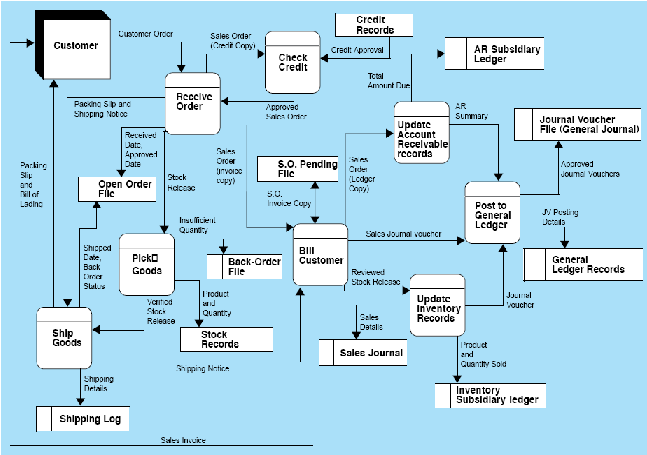
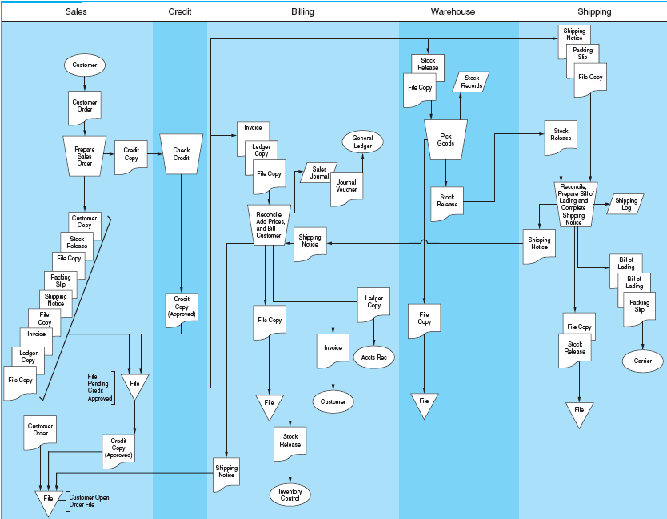
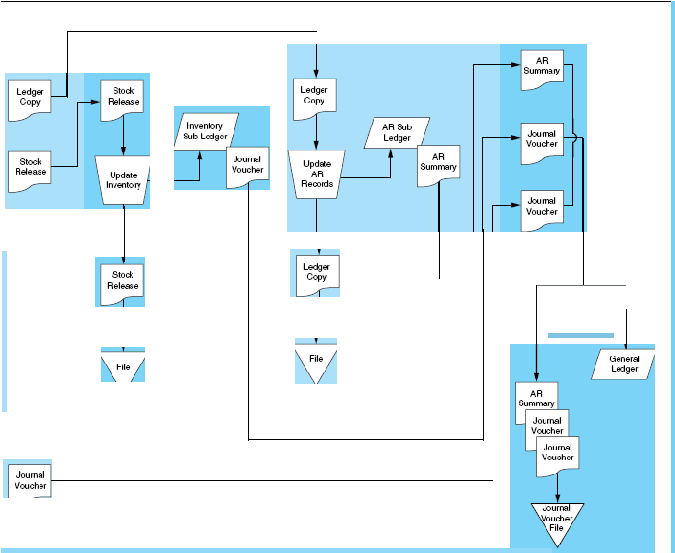
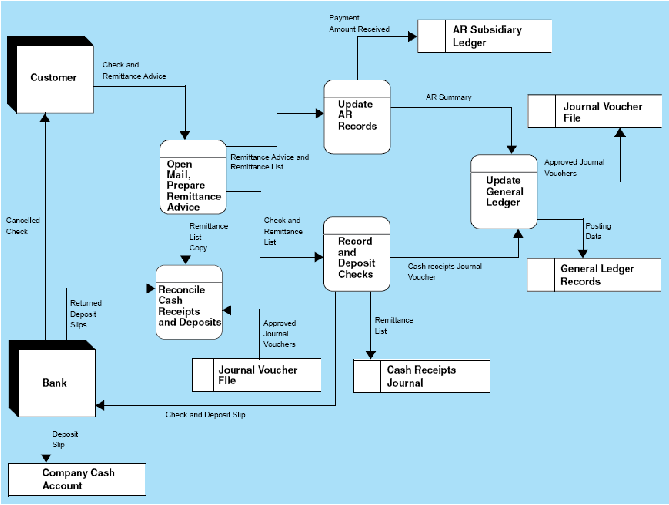
decision-making. AIS is documented in several form, such as Data flow diagram (DFD),
document flowchart, system flowchart, and program flowchart. AIS documentation tools
will be discussed as follows (Romney, Steinbart, 2009):
1. Data flow diagram:
Data flow diagram (DFD) describe the flow of data within an organization, it shows the
source and the destination of
the data or, and also describe the entire process and data
storage.
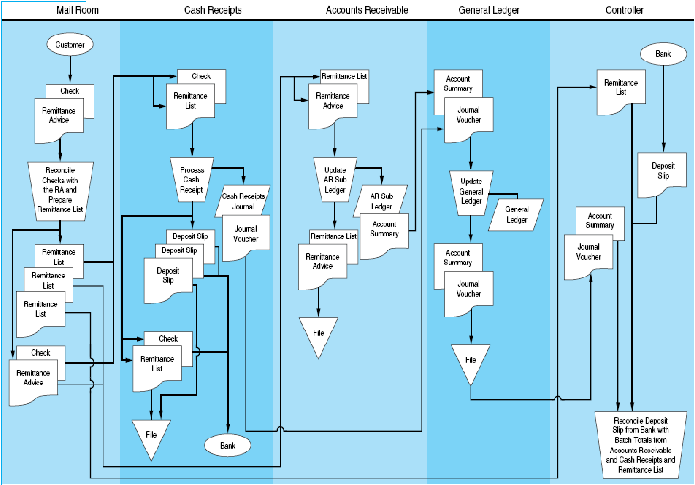
2. Document flowchart:
Document
flowchart
describes
the
flow of
documents
and
information
between
departments within an organization.
3. System flowchart:
System flowchart describes the relationship between input, output and processing within
information system
|
 9
4. Program flowchart
Program flowchart provides information about sequences of operation that is performed
by computer and executes program.
5. Entity relationship diagram
Entity relationship diagram illustrate
the graphical technique
for portraying a data
base schema. It shows the relationships between entities and how these entities are
being modeled
Table 2.1 Data Flow Diagram of sales process based on
Accounting Information
System
|
 10
Table 2.2 Data Flowchart of Sales Process based on Accounting Information
System
|
 11
Billing
Inventory Control
ACcounts Receivable
GeneralLedger
Updale General
ledger from Journal
Vouchrs
and
Reconcile
|
 12
Table
2.3
Data
Flow
Diagram of
Cash
Receipts processes
based on
Accounting
Information System
|
 13
Table 2.4 Data Flowchart Cash Receipts processes based on Accounting
Information System
|
|
14
2.3 Revenue cycle
2.3.1 Definition of Revenue cycle
Revenue is the income of the company derived from the business activities such as sale
of goods and services, revenue is usually collected after customer received the goods or
the
services
has
been
performed by the company. In the financial report, revenue
commonly recorded as “sales”.
Furthermore, Revenue cycle is a “business activities and information processing, which
brings about the providing of goods or services to customers and collecting payment in
terms of cash” (Romney, Steinbart, 2006).
Revenue cycle consist of two major subsystem:
1. Sales Order Processing, which includes tasks such as:
•
Preparing sales orders
In this process, customers will send purchase order, which lists the goods
that are going to be ordered. Sales order will be prepared, this document
provide information about customer’s account number, description of
orders; and the quantities and unit price of each item.
•
Check credit
Before
further
process of customer’s
order, sales department
will check
the
creditworthiness
of
the
customers. This
is
done
to
ensure
that
the
customers have the ability to pay.
|
|
15
•
Shipping products to the customers
Goods
are
shipped
to
customers
after all the procedures have been
properly done. Warehouse department will prepare the goods and the
shipping clerk reconciles the physical items with the stock.
•
Billing customers and properly record the transaction
Customers will be billed after the shipment of goods has been completed.
Billing
customers
before
the
completion
of shipment
will
result
in
inaccurate records.
2. Cash Receipts, which includes tasks such as:
•
Collecting cash from customers
Cash are collected from customers after the billing procedures have been
completed. It is important to ensure that the cash collected have matched
with the amount that should be paid by the customers.
•
Depositing cash in the bank
Cash
is
deposited
in the
bank
after collection
has been completed.
By
depositing the cash, it will ensure that cash are kept in safe place.
•
Adjusting between the payment and the customers transaction
Accounting clerk reconcile between bank record and customers
transaction. This is done in order to check whether customers have paid
the transaction according to the actual amount.
|
|
16
•
Properly record the financial transaction
Financial transaction has to be properly recorded after all the procedures
have been properly done. Accounting
department will update account
receivable ledger and also general ledger.
2.3.2 Revenue cycles control
There are six classes of internal control within this cycle:
1. Transaction authorization:
The
main
objective
of
this
control
is
to ensure that all transactions should be
properly authorized and only valid transaction that can be processed further. In
order to
implement this objective, the
use of credit check, return policy
system
and remittance list is applied to the system. Credit check is to check the
creditworthiness of the
customers and
make sure
that
they are
feasible
(Hall,
2008).
2. Segregation of duties:
Segregation of duties
is
very
important,
this to ensure that no individual or a
department have the authority over control or access all the business processes.
Segregation of functions consists of three rules:
|
|
17
1. Transaction authorization should be separate from transaction processing:
In
this
system,
the
credit
authorization
is being segregated
from all the
processing, this
means
that authorization and transaction processing
is
separate
events.
2.Asset custody should be separate from asset record keeping:
It
is
very
important
to separate asset custody
from the asset
record
keeping
as
to
ensure the assets is keep safe . a person with combined responsibility could steal or
lose inventory and adjust inventory to conceal event.
3. The organization should be structured that perpetration of a fraud requires
collusion between two or more individuals:
The task of
recording
transaction
has
to be
structured
and
carefully
separated.
Subsidiary ledger, journals and general ledger have to be separated between each
other. By separating the tasks,
there will
be less risk in the company and it
is
easier to detect fraud.
Supervision:
Supervision is a form of control in company in which to ensure that all the workflow
is properly done. As according to (Hall, 2008), supervision is often used when
it
is
unable to conduct an appropriate segregation of duties.
|
|
18
Accounting Records:
Accounting records
act
as
an
audit
trail
and
it
is
very important
to
be
properly
maintained,
so
it
will
be
easier to keep track of every process and to find errors
occurred in the system. By using pre numbered documents can keep record of every
single events in the process and it will be easier to identify each documents.
Access controls:
Access controls is crucial for the control of the revenue cycle as when there is no
limited access to certain areas it can lead to fraud action. In revenue cycle, assets that
most needed to be protected are cash and inventories; access to accounting records
such as account
receivable
subsidiary
ledger and
cash journal
has
to be
narrowed
(Hall, 2008).
Independent Verification:
Independent verification is to ensure
that all procedures and accounting
records
is
being reviewed by
the system as to having an assurance in
terms of accuracy and
completeness.
2.3.3 General structure of good revenue cycle management system
Nowadays
many companies are
unable to survive due to the
lack of management skill.
Revenue cycle is one of the most critical components of the management. Therefore, a
good revenue cycle management is highly needed in the organization. Guyton and Lund
had listed four characteristics of good revenue cycle
management system, they are
(Guyton, Lund, 2003):
|
|
19
1. Better information management
Management has to be able to provide real time information as to make sure
the accuracy of data. Every business process
has to be properly documented,
thus, it will improve information management within organization.
2. Tighter accountability
Designing revenue cycle based system for the business operation is important
in order to increase control as well as accountability. However, implementing
revenue cycle based system is not enough, segregation of duties is also highly
needed as to make control become tighter. Lastly, it is suggested for company
to
implement performance-based management
information
system to support
accountability of the company
3. Reduced variability
Automated workflow and approvals will increase efficiency of the company,
as
there
will
be
no paper
work,
all-business process
is
properly recorded.
Managers also need to actively monitor and measure the overall performance.
4. Comprehensive integration
Firstly, in order to increase comprehensive integration, company should
conduct analysis on revenue cycle system and also concentrate on
functions
that considered being critical.
Secondly, company has to encourage controls and policies through rules and
regulation. Lastly, it is recommended
for
company
to
have
automated
workflow and leverage relationship with partners.
|
 20
2.3.4 Threats and Controls in the Revenue Cycle
(Romney, Steinbart, 2009)
Table 2.3.4. Threats and Control of Revenue Cycle
Process
Threat
Control Procedures
Sales Order Entry
1. Incomplete
/
inaccurate
customer
orders
2. Credit Sales to poor
credit customers
3. Legitimacy of orders
4. Stock outs, carrying
costs, and markdowns
1. Data entry checks
2. Credit approval
by
manager,
not
by sales function
3. Signature on
paper document
4.
Inventory control
systems
Shipping
5. Shipping Error:
Incorrect merchandise
Incorrect quantities
Wrong address
6. Theft of inventory
5. Reconciliation
of
sales
order with
picking ticket and
packing slip;
barcode scanner
6. Restrict
physical
access
to
|
 21
inventory,
physical count of
inventory,
RFID
barcode
technology
Billing & A/R
7. Failure
to
bill
customers
8. Billing errors
9. Posting errors in A/R
7. Separation
of
shipping
and
billing functions
8. Data
entry
edit
controls; price list
9.
Reconciliation of
subsidiary A/R
ledger
with
general ledger
Cash Collections
10. Theft of cash
10.
Segregation
of
duties,
minimization
of cash handling
General Control Issues
11. Loss of data
12. Poor performance
11. Back up and
access control
12. preparation
and review of
performance
|
 22
report
2.4 Internal Control
2.4.1 Definition of Internal control
According to Hermanson as cited from Institute of Internal Auditors, internal control
defines as a set of controls that is designed by the management to provide assurance
that the company meet the following objectives (Institute of Internal auditors, 1993),
such as:
1. Reliability and integrity of information
All information in the company is reliable and trustworthy. High
integrity of
information
is
needed as to ensure
that
information being
used is accurate.
2. Compliances with laws and regulations
Internal control implemented in the company has to be
in accordance
with laws and regulations. In this way, it will increase the value of the
company.
3. Safeguard of assets
Assets of the company are usually at high risk, therefore strong
internal control is highly needed in order to protect company’s asset.
|
|
23
4. Efficiency of operations
Efficiency of operations is one of the most important objectives, as by
increased
in efficiency
will
affect
the
overall
performance
of
the
company.
5. Accomplishment of goals
Goals
of
company
are
ensured that
it
has
been successfully
accomplished; this measures the overall performance of the company.
Internal control and business risk are interrelated between each other as it represents a
critical component of corporate governance framework, and this become the primary
mechanism through which organization manage their business risks. Moreover,
internal control is use as the primary by the organizations to minimize the probability
of reaching company’s goal (Wong, 2000).
According
to
Noordin,
“there
are
wide range
definitions
of
internal
control. In its
broadest sense, internal control refers to both administrative and accounting controls”
(Noordin, 1997).
1.
“Administrative control consists the plan of the organization; methods and
procedures that help the management and planning control activities”.
2. “Accounting control consists all methods and procedures that are mainly focused
on authorization of transaction, safeguarding of asset, and the accuracy of the
financial report. Strong accounting controls will increase efficiency and decrease
both data error and fraud”.
|
|
24
There are four objectives of internal control system, which are (Hall, 2008):
•
Safeguards assets of the firm:
Internal
control
system
protect
assets
of
the
firm
from
damage,
loss
and
fraud, this is done by properly check the assets and matched it with the asset
records.
•
Ensure accuracy and reliability of organization’s accounting data:
Internal control system is
responsible to check the accuracy and make sure
that all accounting data is reliable. By having a systematic check on every
accounting data it will minimize on misinterpretation or data error.
•
Promote efficiency of the firm:
Internal control help promote the efficiency of the firm as the internal control
is implemented, there will be an
increase
in the
efficiency of the operation,
thus it will bring a profitable behavior to the firm.
•
To
measure compliance
with
management
prescribed
policies
and
procedures:
Internal
control
system measures
whether
all
business
process
have
been
complied with the management policies and required procedures.
|
|
25
2.4.2 Components of internal control
Based on Committee of Sponsoring Organization (COSO) under SAS 78, there are five
main elements of internal control, they are:
1. Control Environment:
Control environment
is
very
important
for the development of the
internal control,
according to COSO guidance, there are 7 principles of control environment.
Those
principles are:
•
Integrity and ethical values
Integrity
and
ethical
values
have
to
be built and
developed, and
understood particularly on top of management,
so
the
business
environment will have high integrity and ethical values which will result
in better company performance. Rules & regulation on financial reporting
have to be set according to accounting standards (Arens et al, 2006).
•
Commitment to competence
“Competence is the knowledge and
skills
that
is required
to
fulfill tasks
for individual job. Commitment to competence includes the consideration
of
the management towards
competence levels
for
specific
jobs”
(Arens
et al, 2006). Requisite skills and knowledge are being translated from the
levels of competence.
|
|
26
•
Board of directors or audit committee participation
Independent of management is considered to be the characteristic of an
effective board of directors, and the members is involve in all
management’s activities. The board has to conduct a regular independent
assessment for the management’s internal control, by having this
assessment,
the
internal
control
of the
company
will
likely
to
perform
better. In addition, the board with high objectives will effectively reduce
the possibility of overrides existing controls. However, the audit
committee is also having responsibilities such as, maintaining
communications with both external and internal auditor, approval activity
of both audit and non-audit services performed by the auditors of public
companies.
Moreover,
directors and auditors
will
evaluate
issues
related
to integrity and management’s actions (Arens et al, 2006).
•
Management’s philosophy and operating style
The
information
about
importance
of internal control
is
delivered
to
employees through the activities of the management. In this way, strong
internal control would likely to
be
achieved
when
there
is
enough
understanding about the philosophy and also operating style of the
management (Arens et al, 2006)
|
|
27
•
Organizational structure
“Organizational
structure
contributes to
an
entity’s
ability to
meet
its
objectives by providing an overall framework for planning, executing,
controlling, and monitoring activities”(Leung et al, 2004)
•
Assignment of authority and responsibility
Employees are assigned an appropriate levels of authority and
responsibilities
as
to support the implementation of
internal
control
systems, thus goal of efficiency can be achieved (Gramling et al, 2007).
•
Human Resource policies and practices
Personnel play an important role in the implementation of internal
control. High competence and honest personnel is highly needed in order
to achieve efficiency and successful control system. Incompetent and
dishonest personnel will lead to a failure in the control system, thus the
business are unable to reach their goals. (Arens et al, 2006)
2.
Risk Assessment:
Management has to be concern about possibilities of risk and think of an action that
are necessary to overcome the risks. It is recommended for organization to identify, and
analyze about factor that may increase the risk. By having risk assessment, it will help
the company to reduce minimize the risk
|
|
28
3.
Control activities
Policies and procedures have to be established by the company as to ensure the
company to achieve their objectives. There are 5 types of control which support
the development of control activities, those control are:
1. Segregation of duties
“
Segregation
of
duties
ensures
that
an individual does not perform
incompatible duties. When a person commit an error in his work and be able
to conceal
the
error
it
is
considered as
incompatible
duties”
(Leung
et
al,
2004)
2. Proper authorization of transaction and activities
Every transaction and processes should be properly authorized in order to
have
a
strong
control.
None
of
transaction
can
be
processed
if
no
authorization is occurred.
3. Adequate documentation and records
Management has to ensure that documents are adequate for both transaction
and recording activities. Documents provide control over assets and
transaction activities.
|
|
29
4. Physical control over assets and records
Assets and record
have
to be properly
maintained as these two components
are
mostly
at
risk.
When
there
is no
adequate
protection
over
assets
and
records, they might be damage and loss, such event will disrupt the operation
of the management (Arens et al, 2006)
5. Independent checks on performance
Independent check is use to review the work performance of employees. By
having this review, the management will be able to identify any unintentional
mistakes done by the employees, thus high quality control can be achieved.
4. Information and communication
Information and communication system is maintaining accountability of assets
and responsible for the whole record, process and finally reporting the business
transaction (Arens et al, 2006).
5. Monitoring
Avellanet
point
out
that
Monitoring
is
a
set
of
procedures
that
provide
information’s about how internal control should be conducted (Avellanet, 2009).
Management should have monitoring, as it will assess the quality control that has
been
implemented.
Monitoring
usually
done periodically, and it has to be done
properly
as
to
ensure
the
operation
of internal
control
as
intended
by
the
management (Arens et al 2006)
|
|
30
2.4.3 Characteristics of Good internal control system:
Based on Noordin’s (1997) work, he listed eight characteristics of good internal control
system in which an organization might be use to appraise any procedures or transactions,
those characteristics are:
1. Reliable personnel with clear responsibilities:
Personnel play an important role in internal
control. In order to achieve a
successful internal control, high competence
and
honest
individual
is
needed,
otherwise, a good internal control can’t be achieved and there will be a
possibility
that
the system might
be spoiled.
High
competence personnel
will
increase productivity and minimize fraud.
2. Separation of duties:
Separation of duties will increase the accuracy of data as well as minimizing the
fraud. Elements of separation of duties are listed below:
a. Separation
of
operational
responsibility
from
record
keeping
responsibility:
This element refers to the separation between accounting functions and
operating department.
b. Separation of the asset custody from accounting functions:
This activity will
minimize
the
risk and
fraud. For example: cashier
should
not have access to the accounting
ledgers, and book keeper
should
not be
able to handle the cash (Noordin, 1997).
c. Separation
of
the
authorization
of
transaction
from custody
to
related
asset:
|
|
31
Independent
activity between
these
2
processes
will
increase
control
which
will reduce in data error or risk that may related to these activities.
d. Separation of duties in accounting functions:
Every individual should handle different tasks in the accounting department;
one
person
will
not
have
the
authority to
do
all
the
recording
process
throughout all transaction.
3. Proper authorization:
Every processes and transaction in the organization have to be properly
authorized. Ease of controls likely to be achieved, as it is easier to check if there
is
any
error
occurred,
the
supervisor
is able
to
check
from the
authorized
documents.
4. Adequate documents:
Every
transaction needs
to
have
an
appropriate
documentation
and
it
is
also
recommended that every document should be renumbered.
5. Proper procedures:
Every procedure
in the company
has to be made clear and
appropriate.
Procedures provide information about flow of documents and guidance for
record keeping. It is crucial for the company to have proper procedures, so it is
easier
to
track
control
of
every documents
and
processes
that
run
by
the
employees.
6. Physical safeguards:
Inventories and cash are the assets that are high in risk. In order to minimize the
risk
and
losses,
company
should
provide
limited
access
to these
assets,
only
authorized personnel that can access to this function.
|
|
32
7. Independent check:
Periodic review by both external and internal auditor is recommended for
checking the entire systems. The review should be conducted by a personnel who
has
no
direct
contact
with
the
processes, so
as
to
make
sure
that
the
report
produced by the auditor is reliable.
8. Cost benefit analysis:
Implementing control system in the organization is quite costly; it is suggested to
have an analysis in both cost (disadvantages) and benefit of the system.
2.5 Internal controls in Information Technology
2.5.1 Definitions of Information Technology (IT)
Based on Information Technology Association of America (ITAA), information
technology defined as "The design, development, implementation, and management
of computer-based information systems, particularly software applications and computer
hardware".
Nowadays large companies are relying most on information technology
to access
information,
and
especially
processing
and
storage of data.
Alexander point out that
Information technology is an important tool to manage the transactions, information and
knowledge required to expands every aspect of activities (Alexander, 2008).
2.5.2 Control issues in IT environment
The
use of
information
technology
has
increase efficiency in the business operation.
However, in order to keep the efficiency, there
has to be control
activities that able to
|
|
33
control the whole operation of
the IT system. Philee and Philee suggested
four simple
ways that can be implemented by all employees, these are (Philee, Philee, 2009):
1. Use of encryption:
Encryption is tools or software applications that protect important and
confidential
information
from unauthorized
personnel.
By
having
encryption,
there will be more control towards information as
unauthorized personnel
will
not be able to access the data.
2. Data restoration:
Data in the company are mostly at high risk. It is recommended for all employees
to provide back up for all data in the company. Restoration minimize the lost of
data.
3. Virus protection software:
In order to protect data and important information in the company, it is important
to protect computer with virus protection software as to prevent lost and damage
to files.
4. Passwords:
The use of passwords in every business process will limit the access to data and
software,
in this way, only authorized personnel
will be
able
to have access
to
related data and application.
Refer to Green et al 2006,
Data and information
in IT environment are assets of the
company. Unauthorized personnel who made intentional changes to data and
|
|
34
information is a critical issues for the management. Therefore, strong internal control is
highly needed in the information technology in order to meet objectives, as follows:
•
Integrity
relates
to the
completeness, accuracy,
and
authorization
of
information and systems:
Every
information
and
system process
has
to
be
clearly
authorized
by
the
management
and
ensure
the completeness and
accuracy of
the
data. Accuracy
includes valuation, presentation, validity and timeliness.
•
Confidentiality
Confidentiality
refers
to
protecting important
and
confidential
company’s
information from any unrelated parties.
•
Availability of information systems:
Availability relates to information and systems are being ready to use when it is
require by the management.
2.5.3 Internal
Controls in Information
Technology environment
(Green et al,
2006):
1. Development and implementation of information architecture in the
organization:
According to Cummings, information architecture refers to a “ rules and methods
that aim to identify and organize information in a purposeful and service-oriented
way” (Cummings, 2009). Maintenance and development of information overtime
is improved by having the implementation of information architecture.
|
|
35
2. Identification of potential and impact of business risk:
Management has to identify possibilities of potential risks result from
implementation of information systems that may happen in the, and also identify
the impacts that may affect the organization. In this way, the management will be
able to minimize loss related to the organization.
3. Existence of policies and standards regarding information system:
Policies and security standards have to be made in order to meet the objectives
and ensuring that workflow in the organization are according to the standards. By
implementing these policies will increase control in the business environment.
4. Existence of Procedures that regulate users:
Users of information systems need to be regulated as to create high control in the
IT environment. Therefore, procedures are made in order to regulate users of
information. Procedures are use to determine several important tasks in the
organization such as access of new users, unauthorized personnel, and terminated
employees from using the access.
5. Development of security standards to support the objectives of security
policy:
The aim of development of security standards is to assess whether the security
standards
have
meet the objectives of the policy.
By having this development,
the
management will be able to decide what needs
to be done if the standards
|
|
36
have
not
meet
the
objectives,
this
will
improve
the controls
in
the
IT
environment.
6. Implementation of Appropriate controls and vulnerability assessments:
The management has to ensure that implementations of controls are in an
appropriate way, and also independent assessment controls have been conducted
within a year
7. Limitation of access to confidential facilities:
Access to sensitive area or confidential facilities have to be restricted and it is
recommended to
have special security such as card or key reader,
finger that
is
useful to authenticate the users. Management also need to review user access
appropriateness based on their responsibilities.
2.6 Fraud
2.6.1 Definition of fraud
According to SAS 82, fraud is defined
as fraudulent actions that cause material
misstatement to the financial statement. “ Fraud is a serious threat to organization, it
can
take in
various action but
the
impact are all the same which
result
in
loss
of
value to the stakeholders” (Avellanet, 2010)
|
|
37
2.6.2 Actions of fraud:
Refer to Reinstein and Bayou, Actions of fraud differ from objects of fraud. Action
is an activity carried out by the individual such as stealing and misusing, while the
object is the target of the activity such as asset, inventory (Reinstein, Bayou, 1999).
However, Objects can be
in form of both tangible and intangible. Fraud action
is
classified into two, which are:
1.
Fraudulent financial reporting
Fraudulent
financial
reporting
is
an
intentional
financial
misstatement or
omission of amounts or disclosures with an intention to deceive users (Reinstein ,
Bayou, 1999). Actions of fraudulent financial reporting include:
(a) Manipulation and falsifying of data, transaction and record of activities
(b) Misrepresentation
or omitting
of events,
transactions and
other relevant
information
(c) Misapplication of accounting principles during recording activities
2. Misappropriation of assets
Misappropriation of assets is a fraud action, which involves theft or misuse of
company assets. The loss of company asset is an important management concern,
as this loss will bring unprofitable behavior for the company.
|
|
38
2.6.3 Motives of fraud
There are
various factor
that drives individual for committing
fraud. According
to SAS 82 (par 6),
motives of
fraud are classified
into two
factor, these
factors
are:
Motivation: Motivation is a form of pressures or initiative to commit fraud.
Refer to Reinstein and Bayou, SAS 82 has divided motivating factors into
two, which are:
1. Motivating factors to misstate financial statements:
The factors that drive individual to misstate financial statement include:
a.
Managerial
factors
pertaining
to
management's
abilities,
pressures,
style and attitude regarding internal controls and financial reporting
process.
b.
Industrial factors including economic and regulatory conditions
c.
Operating and financial factors from the nature of the company such
as, financial and profitability conditions.
2. Perceived opportunities
According to Robertson and Louwers (1999), “ an opportunity is an open
door for solving the problem in secret by violating a trust”.
Perceived opportunities are important factor that drives individual to
commit fraud.
|
|
39
|