 8
CHAPTER
II
BUSINESS
ANALYSIS
2.1
Industry Analysis
Poultry industry in Indonesia is the most advanced in the livestock sector. It
has
one
of
the
brightest
growth
prospects in
Indonesia.
60%
of
production is
concentrated in Java, with the balance distributed as follows: 30% in Sumatra, 6% in
Kalimantan
and 4% in Sulawesi. Its rapid growth is fuelled by a huge
market
potential and
the
relatively
low
consumption
on chicken
in
Indonesia compared
its
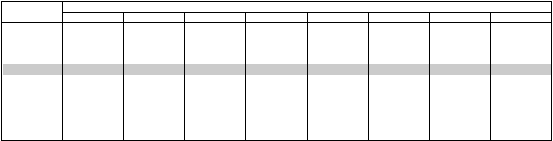
South East Asia neighbors as can be seen in the table below:
Table 2.1 : Chicken Consumption Per Capita in ASEAN Countries
Country
Year
1995
1996
1997
1998
1999
2000
2003
2004
Laos
Kamboja
Vietnam
Myanmar
1.9
1.5
1.7
2.3
1.9
1.7
1.9
2.6
1.9
1.7
2
2.8
1.9
1.7
2.1
3
1.92
1.65
2.22
3.42
1.93
1.68
2.3
3.48
1.95
1.81
2.62
3.64
1.97
1.87
2.74
3.82
Indonesia
4.4
4.6
4.4
2.9
3.27
3.45
3.92
4.22
Phillipines
Thailand
Singapore
Malaysia
Brunai
5.8
10.3
24.9
26
39.8
6.5
11.2
24.9
26.5
42.6
7
11.8
24.5
27
46
6.8
10.8
25
26
45
7.61
11.5
27.2
34.1
45.63
7.59
12.2
26.8
29.63
47.12
7.99
14.9
27.8
36.24
46.2
8.02
15.28
28
36.74
46.36
Source : FAO
In
Indonesia, poultry
industry
also
has
relatively
low
competitiveness and
profitability compared to poultry producers in other countries, notably USA, Thailand
|
 9
and Brazil. The industry relies for almost 70% of its production inputs on imported
feedstuff and animal health care products like vaccines and others.
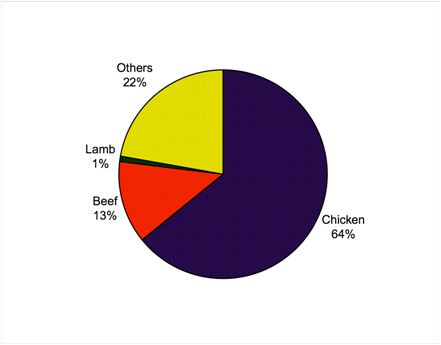
Based on the national meat consumption data for year 2003, chicken was at the
top
position,
which
is
64% of
total meat consumption,
far
higher than
other
meat
products,
such
as
beef
13%
and
lamb
1%
(chicken was
still
favorite
meat
for
Indonesians,
being
the
cheapest
source
of
animal protein and
for
a
predominantly
Moslem population, chicken is a key element of the meat diet).
Figure 2.1 : Indonesia’s Meat Consumption per Capita 2003
Source: FAO and Ditjen Peternakan
In year 2002 to 2004, the combined installed production capacity of feedmills
in Indonesia increases by an average of 3.6% p.a, from 5.5 million MT in 2002 to 5.7
|
 10
million MT in 2003, and 5.3% p.a from 5.7 million MT in 2003 to 6.0 million MT in
2004. This is in line with the growth of chicken meat production.
Table 2.2
:
National Feedmill and Chicken Meat Production
2002
2003
2004
Feedmill Production
5.5
5.7
6.0
Chicken Meat Production
1.1
1.1
1.2
Source : FAO and Ditjen Peternakan
For a company to succeed in the poultry business, it needs to fully integrate its
upstream
and
downstream
operations.
This
comprises several
major
production
activities: feed production, DOC (Day Old Chick) breeding, chicken farming, chicken
dressing and processing, and distribution. In Indonesia, although there are more than
15 poultry operators, only 3 are fully
integrated. These are PT Charoen Pokphand
Indonesia Tbk, PT Japfa Comfeed Indonesia Tbk and PT Sierad Produce Tbk.
2.1.1
Competitor Analysis
2.1.1.1
PT
Charoen Pokphand Indonesia Tbk (Charoen
Pokphand)
Charoen
Pokphand
began
commercial operations
in
1972
with
feeds
production capacity of 20,000 tons a year in 2.4 hectares of land area in Jakarta. The
|
|
11
products consisted of, among others, cattle feeds (cow, pig) and poultry feeds (layers,
broiler and duck). In 1976 and 1979, the company expanded its operation to Surabaya
and Medan by setting
up factories with capacities of 24,000 tons and 80,000
tons a
year, respectively.
After
undertaking
several production
improvements, presently,
Charoen
Pokphand
has
annual continued
total
production
capacity of
650,000
tons
in
its
factories in Jakarta, Surabaya and Medan.. The factory in Jakarta has a land area of
27,284 square meters (with production capacity of 200.000 tons a year), Surabaya has
a land area of 42,565 square meters (with production capacity of 250,000 tons a year),
and
Medan
has
a
land
area of 17,595
square
meters (with production capacity
of
200,000 tons a year).
Witnessing the increase in the market demand for shrimp feeds, in 1988,
Charoen
Pokphand
expanded its
business
to
the
production
of
shrimp feeds
by
establishing a
factory
with a capacity of 40,000 tons a year
in Medan. To
further
strengthen
its
market position
in poultry
feeds, on April 24, 1990, the shareholders
approved
to
take over
80%
of
the shares of
P.T
Charoen Pokpand
Jaya
Farm, a
company domiciled in Jakarta and engaged in poultry and other animal husbandry.
Charoen Pokphand became a public (listed) company on 18 March 1991. In
2003,
despite sales
growth
of
9.93%
in
2003
and
11.31%
in
2002,
the
company
suffered a net loss of Rp 21.8 billion in 2003, and a profit of Rp 131 billion in 2002.
Appendix 4 shows the financial information in more details.
|
|
12
2.1.1.2
PT Japfa Comfeed Indonesia Tbk (Japfa)
Established on 18 January 1971,
Japfa became a public (listed) company on
23 October 1989. With total production capacity of 1.6 million tons per annum, Japfa
is one of the leading feed manufacturers in the country. Of the total feed produced by
Japfa
today, 10%
is used
for
internal
breeding operations
while
the
rest
is sold
to
local farmers and independent distributors.
Japfa
attributes
its
success
in
feed
production to
five
critical
factors:
a
sophisticated feed technology system, an excellent feed formulation strategy, a strong
raw materials procurement capability, a high capacity utilization rate, and
unrivalled
distribution network.
Japfa places equal emphasis on producing high quality feeds and maintaining
quality
consistency
of
its
feed.
It
boasts
of
an
advanced
feed
technology
system
which
enables
it
to
implement a
stringent
quality
assurance
program.
In
feed
formulation, it has a team of qualified nutritionists who are capable of tailoring to a
particular set of feed specifications. This capability is a major benefit to customers as
a precisely formulated feed produces the best results and is also cost efficient.
In
farming, Japfa enjoys
a
high
level of
integration with
its subsidiary, PT
Multibreeder Adirama Indonesia Tbk. Established in 1985 and publicly listed on the
Jakarta and
Surabaya
Stock
Exchanges
in
1994,
Multibreeder
currently
operates a
number
of
poultry
breeding
farms
to
produce
DOCs
located
throughout Indonesia.
Most of Multibreeder’s DOCs are sold to local commercial farmers.
|
|
13
In 2003, JPFA sales growth was 10.02% and 3.14% in 2002, and resulting a
profit of Rp 151.9 billion in 2003, and Rp 1,088 billion in 2002. Appendix 5 shows
the financial information in more details.
2.1.2
Bird Flu Outbreak
Bird
Flu outbreak,
which
posed
a
serious
threat
to
the
poultry
industry
in
Indonesia, in fact did not influence the national chicken production level in 2003 and
2004. Table
2.2 shows
that the
national
chicken production
has
an
increase
of
9%
YoY, from
1.1 MT
in
2003 to
1.2 MT
in 2004.
The consumer
demand decreased
slightly
when
the bird
flu outbreak was first announced.
Some
articles support this
information as shown in Appendix 7 to 9.
2.1.2
Commodity Price
In poultry businesses, production cost is highly
influenced by the
fluctuation
in
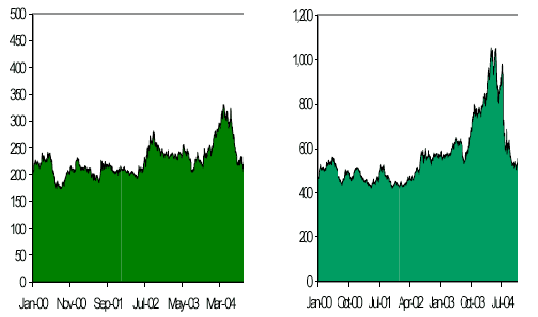
raw material price, especially for two major commodities, corn and soybean meal
(SBM) as shown in Figure 2.2 below, which together account for about 70% of total
production
cost.
Most of
these are
imported,
and
therefore, are closely
related
to
exchange
rate
risk. The ability
to
take good
inventory position
and
forecasting,
and
the ability to transfer the increase of production cost to selling price are the major key
factors to success in this industry.
|
 14
CORN
SBM
Figure 2.2 : Corn and SBM Price (in USD/bushel)
Source : Company Data
2.2
Company Analysis
PT Sierad Produce Tbk is an entity resulting from the merger in 2001 of four
companies conducting
the core
business
of
Sierad
Group.
These
were
PT
Anwar
Sierad
Tbk, PT Sierad Produce
Tbk, PT Sierad Feedmill
and PT Sierad Grains. Its
core
businesses
include the
production
of
primary
processed
and
poultry
feed,
breeding
and hatchery,
growing
farm,
slaughtering and production of
further
processed and value added chicken products, poultry equipment, fishmeal production,
|
 15
fast
food and animal
health and pharmaceutical.
8
The company,
formerly PT
Betara
Darma Ekspor Impor, was incorporated on 6 September 1985. Its current
name was
adopted on 27 December 1996 in preparation
for its successful public listing on the
Jakarta Stock Exchange.
“Being
focused,
we
at
Sierad Produce would
like
to
be concentrated in
the
food related industry.
Our ultimate goal is for every Indonesian citizen to have the
opportunity and affordability to buy our products at very affordable prices, which is
actually to fulfill the dream of the Company to be one of the leading food companies
in Indonesia”, said Mr. Budiardjo Tek explaining the vision of the Company.
9
2.2.1
Business Description
2.2.1.1
Feedmill
Sierad Produce is recognized as one of the largest feeds producers in
Southeast
Asia,
with
state-of-the-art
facilities and
production
capacity
of
800.000
metric
tons per annum.1
0
Sierad Produce’s
feedmills,
located
in different
parts of
Indonesia,
are
computer-automated to
ensure
consistent
product
quality
and
operational efficiency at all stages of production.
Sierad
Produce’s
unique
competitive advantage,
stemming
from
its
use
of
expanders in
its production process,
ensures the
production of
hygienic, nutritious
8
The last two were divested in 2006
9
Quoted based on direct interview
10
PT Sierad Produce Tbk - Company Profile
|
|
16
and highly digestible feeds. It is not surprising then that Sierad feeds are the “feeds
of choice” for many chicken growers in Indonesia.
2.2.1.2
Breeding
Sierad
Produce
breeds
parent stocks
of
different strains,
which are
sourced
from foreign and local grandparent stockbreeders.
The parent stocks in turn produce
eggs that are then hatched to become the final stock of day-old-chicks (DOCs)
Sierad
Produce ensures the
production
of
high quality
DOCs
by
operating
modern closed-house breeding
farms,
fitted
with
tunnel ventilation, cooling
pads,
foggers and automated feeding and drinking systems.
Sierad Produce implements strict bio-security and vaccination programs in
its
breeder farms to ensure that the flocks are consistently disease-free.
Sierad Produce’s
breeding facilities produce up to 105 million DOCs every year.
2.2.1.3
Hatchery
For Sierad Produce,
“the art of hatching eggs
into healthy
DOCs”
is a noble
mission and a year-round pursuit. Sierad Produce’s hatchery operations adhere to the
highest standards and employ the latest technology and “best practices.”
|
|
17
Sierad Produce’s hatcheries use modern machines and equipment supplied by
well-known
international suppliers of setters and hatchers. Its
hatchery facilities are
capable of hatching up to 120 million eggs per annum.
2.2.1.4
Growing Farm
Sierad Produce raises the DOCs to become broiler chicken, either in the more
modern company-owned closed house farms or through contract growers who largely
use the more traditional open-houses.
As in its breeding farms, Sierad Produce also
employs strict bio-security and vaccination programs in
its
final stock broiler farms.
Sierad Produce constantly motivates and assists its contract growers to increase their
net income by educating them and assisting them to exceed company-set productivity
standards such as feed conversion ratio, mortality, body weight and growing days.
Sierad Produce’s partnership with its contract growers plays a vital role in the
nation’s
socio-economic development,
most
especially
in
the
countryside.
Sierad
Produce
provides
its
contract
growers
with
the
full
package
of
production
inputs,
such
as,
day-old-chicks,
feeds,
poultry
health
care
products,
technical
assistance
as
well as education in the
latest
farm management techniques. Sierad Produce finally
provides the
logistical
support
to
ensure
the
efficient
distribution
of
full-grown
chicken when they are ready for harvest.
Sierad Produce helps elevate the income and the quality of life of
its contract
growers,
their
families
and
other
dependents
by providing them
those production
|
|
18
inputs and
capital
goods,
which
would have otherwise been
unaffordable or
inaccessible for many of them.
2.2.1.5
Slaughterhouse & Poultry Food Processing
Sierad
Produce’s
slaughtering
facilities are
among
the
most
modern
and
hygienic in the
country.
The
facilities and processes are
HACCP-certified. Sierad
Produce has slaughtering capacity of 8,000 chickens per
hour. The complex process
involves scalding,
plucking
and
eviscerating,
cutting,
deboning
and
chilling
or
freezing. Sierad Produce strives to optimize its profits by continuously creating added
value thru the entire value chain of primary and further processing. Sierad Produce
ensures that all of its processes and procedures conform to the “halal” requirements.
Sierad Produce
takes
pride
in the
quality of
its dressed chicken
and
further
processed
products,
and
for
which
it
has
become the
“supplier
of
choice” for
the
overwhelming
majority
of
international franchised
fast
food
chains
operating
in
Indonesia.
2.2.1.6
Fast Food
Sierad
Produce
has
a
two-faceted
involvement in
the
retail
food
industry,
firstly
through its exclusive franchise for Wendy’s Indonesia, and secondly through
|
|
19
its
exclusive
license
for American-based
Hartz “all
you can
eat”
chicken
buffet
restaurants for Indonesia and selected countries in Asia.
2.2.1.7
Supporting Operations
Sierad
Produce
operates
sophisticated laboratories
in
various
parts
of
the
region
to
help ensure
that
only
high
quality
products are
produced
at
each
of
its
facilities: feedmills, breeding farms, hatcheries, broiler farms, slaughtering and
further
processing.
Sierad
Produce
also
produces
plastic
poultry
equipment using
injection and
blow
techniques for
automatic
drinkers,
feed
pans and
other
similar
poultry equipment, and animal health care and pharmaceutical product, to supply the
internal
requirements of
its
breeding
and
contract
farms
as
well
as
those
of
independent farmers
2.2.2
SWOT Analysis
This
analysis
involves monitoring
the
external
and
internal
marketing
environment. Once the Company has performed a SWOT analysis, it can proceed to
develop specific goal for the planning period.
The analysis starts from the determination of key strengths of the Company:
1. Integrated Business Strategy
|
|
20
With
vertical
integrated
business,
the
company
will
be
more
competitive,
and
have better supply and distribution chain since all units can support the operation
of each other.
2. Available Capacity
The company still has enough capacity to increase their production volume in the
future. The feedmill’s capacity is one of the largest in South East Asia, while its
Slaughterhouse is
one
of
the
most
modern
and
largest
in
Indonesia,
with
slaughtering capacity of 8.000 birds per hour.
3. Bio Security System
The company has implemented
strict bio security system to ensure that the
product is hygiene, healthy and safe to be consumed.
4. Halal and HACCP Certification
Through
this
certificate,
the
product
could
be
consumed
by
every
people
and
could meet the international standard for fast food operators.
5. ERP System
The company had collaborated with Microsoft Indonesia to implement Microsoft
AXAPTA for better reporting, planning and controlling.
Instead, with the current situation, the Company faced some problems, which
put it in the weak position such as:
1. Slow Corporate Growth
One
of
the
reason why
corporate
grew slow
was
lack
of
working
capital.
The
Company ran the business only by internal financing. It could not get any external
|
|
21
source of financing, while
the obligations
to
the
Bondholders and Lessors
were
still outstanding.
2. High Financing Cost
Since the Company has a good relationship with some suppliers, the company is
allowed
to
get
financing
from
suppliers.
However,
the
cost
become higher
compared to the Bank loan, since the suppliers take a higher margin.
However, this weak position has challenged the Company to find the ways for
improvement and to grab the following opportunities in order to increase its sales in
the future, considering that it still has some key strength to be further developed:
1. Increasing Demand for Modern Slaughterhouse
As
result
from
Bird
Flu
disease, some people are
more
concern about healthy
chicken, and therefore, it is possible to increase the production level in the future
due to the increase of demand, where the product has met the required standard.
2. Limited local brand for dressed chicken
The
brand
of
Sierad’s
dressed
chicken is
“Delfarm”.
Since
there
are
seldom
branded chicken in the market, it is an opportunity for the Company to built brand
awareness and treat the product in an exclusive one that offer
value added to the
consumers, compared to the
other
similar
product.
(Considering
that chicken
is
commodity product)
3. Low poultry consumption Level
As
mentioned earlier,
the chicken
consumption
level
per capita
in
Indonesia
is
low compared to other countries
in South
East Asia.
Since
the
level of
|
|
22
consumption
is closely related with
the
GDP rate,
it
means that if
the
income
(GDP) level in Indonesia is increase, so the demand of chicken will increase too.
Besides strength,
weaknesses,
and
opportunities,
the
Company
was
also
threatened by some factors as follows:
1. Increasing Raw Material and Energy cost
Fluctuation in raw material price, especially for imported ones, and an increase of
energy
cost
are
two
major
threats
for
the
company to
become
competitive
compared to the others.
2. New Entrance
New
entrance that
comes with
sufficient
working
capital,
facilities,
knowledge
and skill can threaten the company to maintain its current position.
2.2.3
4
P
Analysis
The 4 P analysis
is
important to determine the
marketing objectives of the
Company and strategies to be taken
in order to increase the sales (Kotler, 2006, p.
245). The components are product, price, place and promotions.
For product, although the Company produces commodity type product, it has
own brand, to differentiate the products to other competitors’ and to give value added
to the customers.
The Company’s strategies to develop its products are as follows:
1. To increase brand awareness, through advertising, campaign, etc.
|
|
23
2. Product Differentiation and Segmentation based on income level and customer’s
target. For example, the
low-end
customer
in
selected area
will
prefer
to
buy
cheaper product rather than product with premium price.
3. Customer satisfaction monitoring
Regular monitoring is very important in order to know whether the products are
acceptable, and the existing customers are willing to repeat the order.
4. Research and Development to create innovative product.
For pricing, the Company uses the 2 strategies as follows:
1.
To implement premium pricing
for superior product and
at par
pricing for
the
standard one.
It means that the pricing strategy is closely related to the quality of product.
2. To monitor profit margin per product, per customer, and per distribution channel.
The company also has distribution (place) strategies as follows:
1. To open new branch which have closer access to the market in order to reduce the
distributor’s role.
2. To expand the distribution channel in both modern and traditional market.
Promotion strategy
also
takes an
important
role,
since
even
though
the
Company can produce qualified product, competitive pricing and distribution place,
without
good promotion
strategy,
it can
not
successfully
obtain
its
goal. Therefore,
the Company has taken promotion strategies as follows:
|
 24
1. Customer acquisition by increasing brand awareness and product differentiation,
and also customer retention by maintaining the best quality and creating incentive
program.
2. To
implement Key
Account
Management
Concept
in
order
to
give
optimum
service to the customers.
2.2.4
Financial Performance
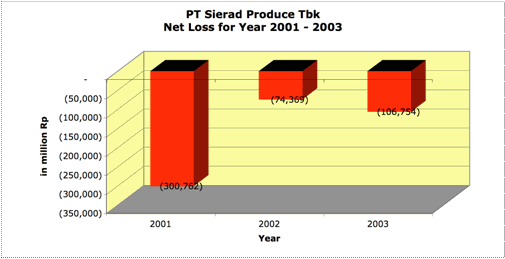
The company’s sales growth was -14.4%
in 2003 and 0.60%
in 2002 which
resulting a net loss in
the sum of Rp 106.8 million in 2003 and
Rp 74.3
million in
2002.
Figure 2.3 : Net Loss For Year 2001 - 2003
|
 25
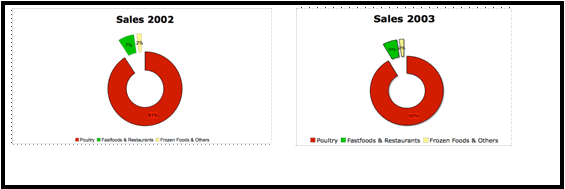
The proportion of sales in 2002 and 2003 are as follows:
Figure 2.4 : Proportion of Sales 2002 - 2003
Source : Company’s Annual Report 2002-2003
Earning
from
operations
before
interest,
taxes,
depreciations and
amortizations (EBITDA) fell from Rp 62.1 billion
in 2002 to just under Rp 1 billion
in 2003. Operating income also declined, from Rp 21.1 billion in 2002 to losses of Rp
41.8 billion in 2003.
For
financial
ratios,
current
ratio
was
remained
unchanged at
3.4:1.
Shareholder equity rose from Rp 74.78 billion to Rp 205.34 billion, due to fixed asset
revaluation
of
Rp
237 billion.
Solvency
improved
considerably:
the
debt
to
equity
ratio
improved
from 14.4:1
in 2002 to 5.2:1 in 2003, and debt to total
assets from
0.93:1 to 0.84:1.
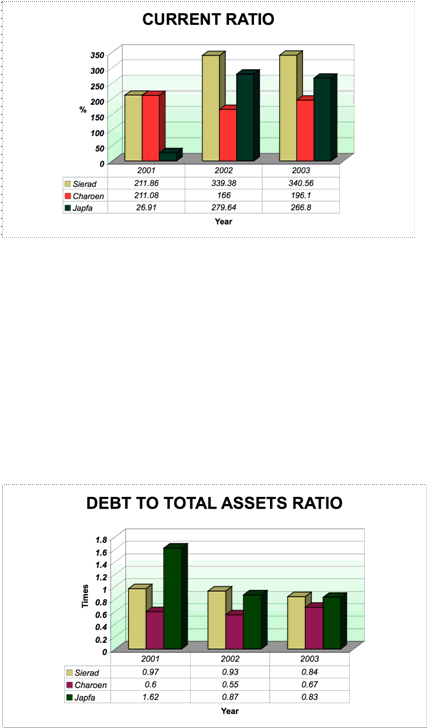
Below
is financial ratio comparison between the
Company and its
competitors, PT Charoen Pokphand Indonesia Tbk and PT Japfa Comfeed Indonesia
Tbk:
|
 26
Figure 2.5 : Comparison – Current Ratio for Year 2001 – 2003
The
above
comparison
shows
that
the
current
ratio
of Sierad
was
higher
compared to Charoen and Japfa, which is 211.86 percent in 2001, 339.38 percent in
2002, and 340.56 percent in 2003. It means that in term of liquidity, Sierad was more
liquid compared to its competitors for year 2001 – 2003.
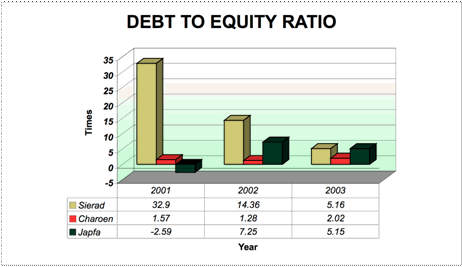
Figure 2.6 : Comparison – Debt to Total Assets Ratio for Year 2001 – 2003
|
 27
It
shows
that for
Sierad,
the proportion of debt
to
total assets
was
0.97
in
2001, 0.93 in 2002, and 0.84 in 2003, which was
higher than
its competitors in the
same
period. It
means
that Sierad
used more debt
to
finance
its assets,
rather than
equity.
Figure 2.7 : Comparison – Debt to Equity Ratio for Year 2001 – 2003
It shows that for Sierad, the comparison of the amount of debt financing to the
amount of equity financing was higher than its competitors, which was 32.9 times in
2001, 14.36 times in 2002 and 5.16 times in 2003.
|
 28
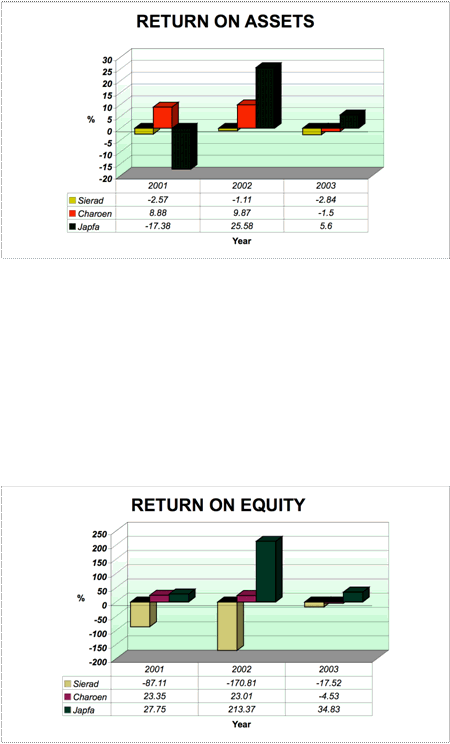
Figure 2.8 : Comparison – Return on Assets for Year 2001 – 2003
For Sierad,
the amount
of profit (net
income) produced
for a given
level
of
assets showed
negative amount, since the Company did
not book profit during
that
period. The percentage was lower than its competitors, except the one in 2001, where
Japfa was the highest, resulting from loss of Rp 494 billion in that period.
Figure 2.9 : Comparison – Return on Equity for Year 2001 – 2003
|
|
29
The purpose of this ratio is similar to that of the return on assets ratio, except
that it
focuses on the owner’s initial investment (represent by the equity) rather than
total assets.
Based on
the above
information, it shows
that the return
of
equity
of
Sierad was lower compared to its competitors.
The details of financial information are shown at Appendix 6.
|